A spectral balancer
Measures the spectrum, compares it to an absolute reference curve and steers the whole tonal balance towards it. Useful when a mix leans too dark, too bright or too heavy.
Adaptive spectral shaper
SPECTRA reads your mix as it plays and evens out what doesn’t belong: resonances, build-ups, holes. Where other adaptive tools decide the goal for you, SPECTRA lets you shape it: six nodes on the target curve, and the correction follows.
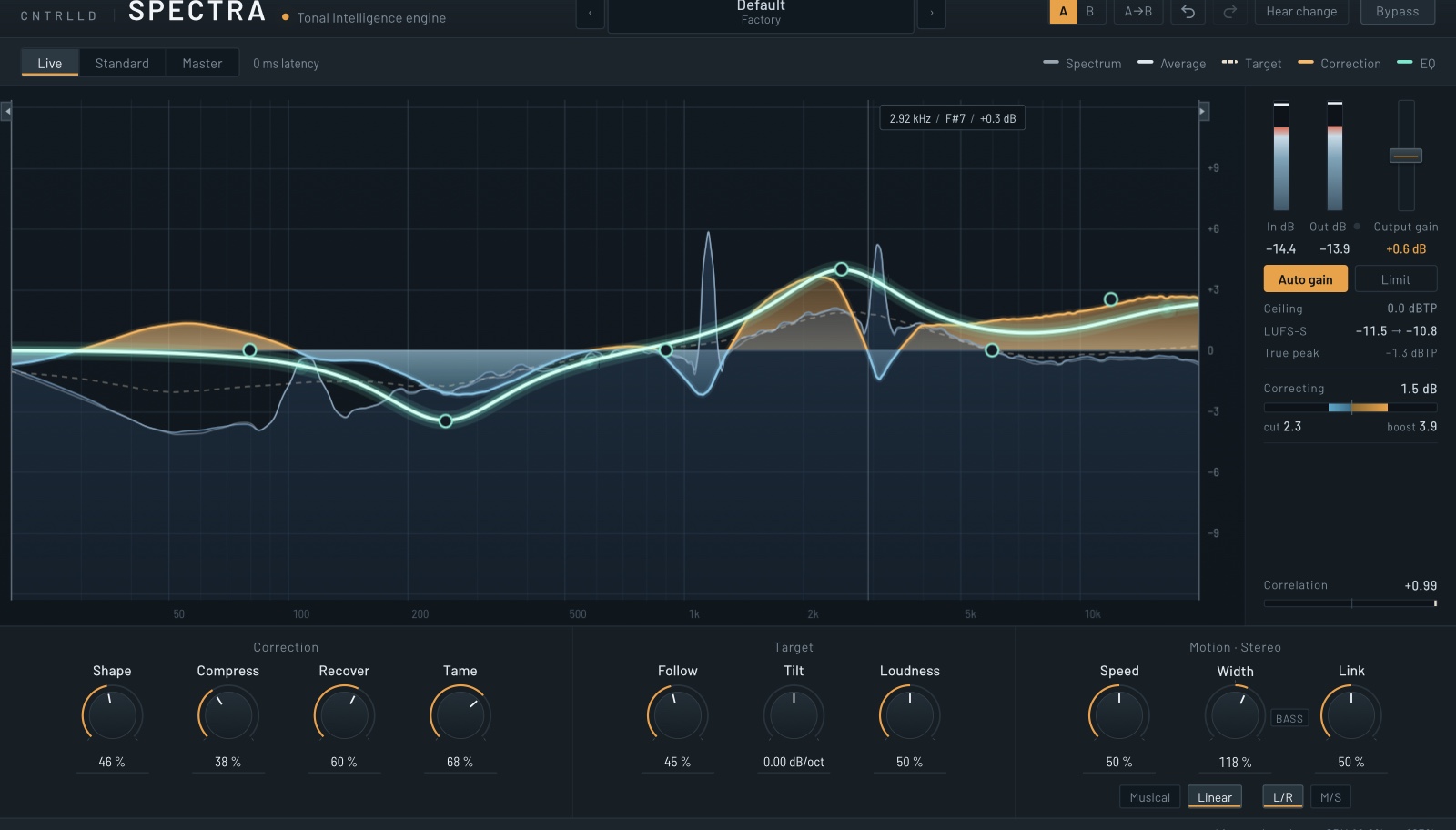
Two ideas, one control
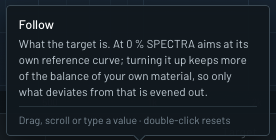
There are two schools of automatic tone shaping. SPECTRA does both, and Follow blends between them without steps.
Measures the spectrum, compares it to an absolute reference curve and steers the whole tonal balance towards it. Useful when a mix leans too dark, too bright or too heavy.
Leaves your material’s own macro balance alone and only corrects what sticks out of it: resonances, masking build-ups, holes. Useful when the balance is right, but the detail isn’t.
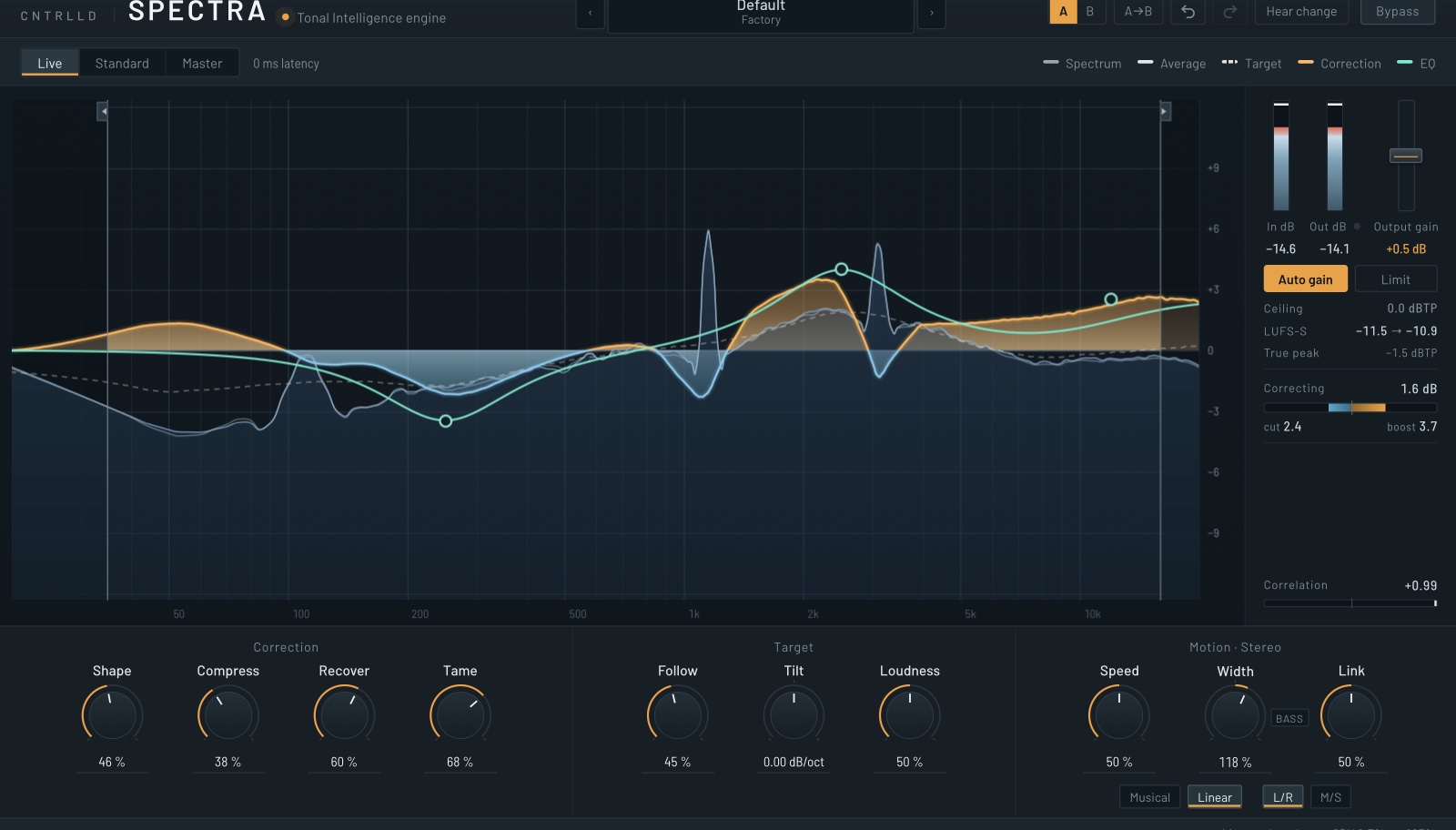
The editable target
Six draggable nodes form an EQ curve that is added to the target itself. SPECTRA doesn’t colour its output afterwards; it steers towards the shape you drew. So the automatic correction works with your decision instead of fighting it.
Correction
Two paths work towards the same target at different speeds. Two more controls decide how hard each direction pushes.
Slow and EQ-like. Moves the overall balance towards the target the way you would with a broad equaliser.
Fast and dynamic. Catches a resonance the moment it rings, and lets go when it’s gone. Musical or Linear motion.
How strongly both paths move up. More Recover opens up what is hidden or masked.
How strongly both paths move down. Works hardest around 3 kHz, where the ear is most sensitive.

Three variants, one curve
All three share the same analysis, target and solver. Switching changes how the correction is realised, not what it is. The latency is reported to your DAW, which compensates for it.
A minimum-phase filter cascade with no latency at all.
The same cascade, with the audio held back a few milliseconds so the correction gets a head start.
Fully linear phase: no phase shift at all, with fine low-frequency resolution.
L/R or M/S in every variant: the whole engine can work on mid and side separately. Click-free switching between variants and channel modes, while playing.
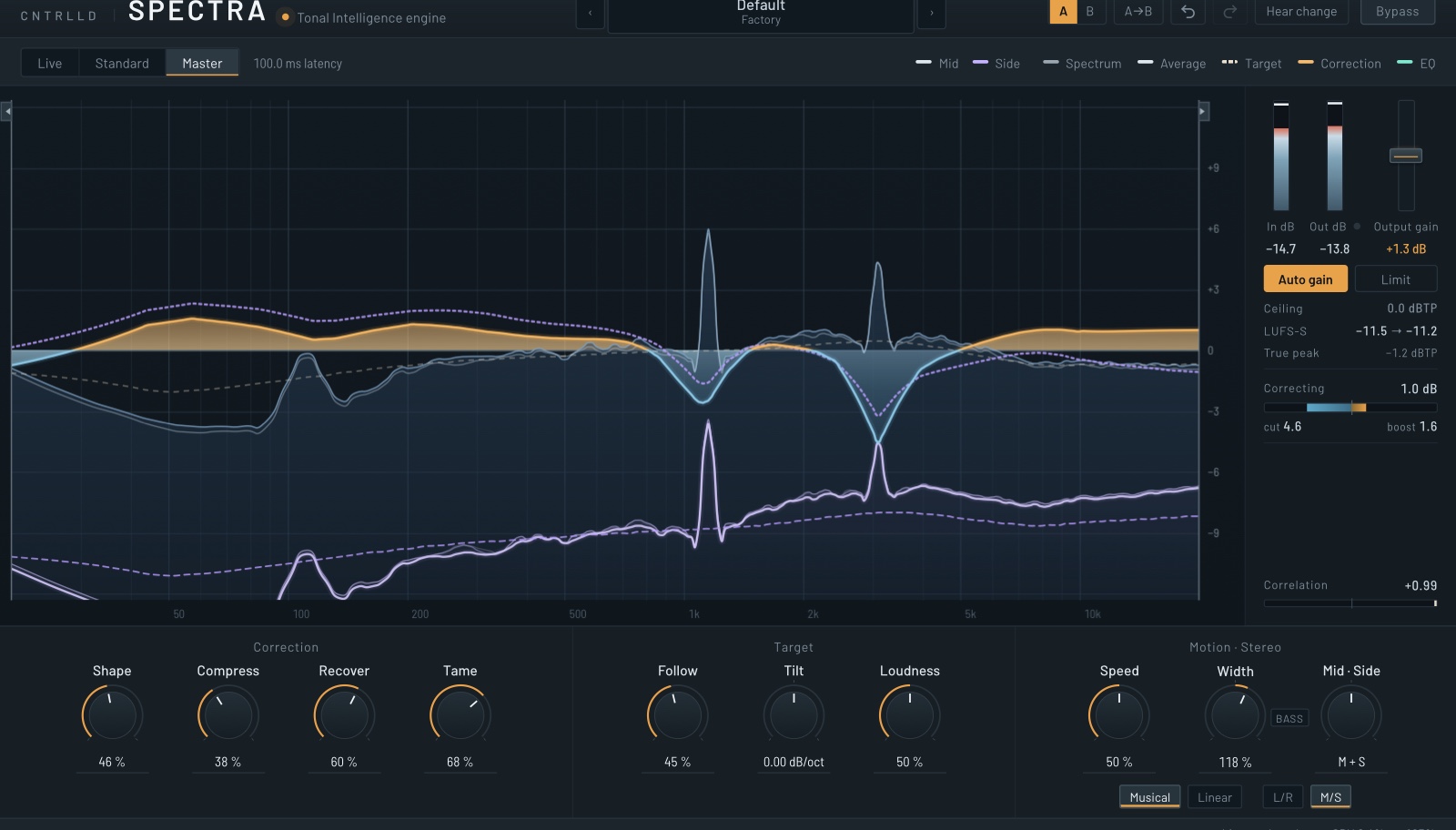
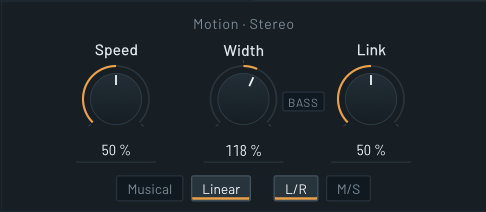
Motion · Stereo
Width works in the manner of a classic analogue stereo processor: only the side signal is filtered, opening the sides above a few hundred hertz. No saturation, no harmonics added.
Engineering
An adaptive processor makes decisions all the time. SPECTRA makes them the same way, every time, whatever your DAW asks of it.
Output tested bit for bit across buffer sizes. A bounce sounds exactly like playback.
A moving correction leaves almost nothing behind, measured against the music.
Every DSP check runs at six sample rates.
DSP checks, interface self-tests and plug-in validation at its strictest level.
A build-up that drops the bass isn’t read as a thin mix. The empty low end isn’t filled, so the drop doesn’t land louder than the rest.
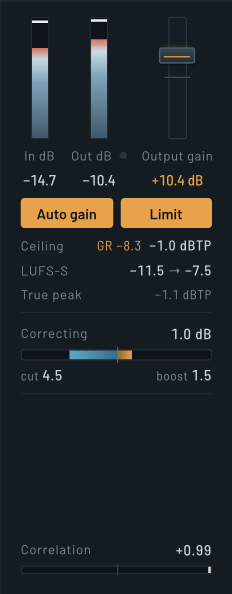
Hear the change in tone, not in level. The makeup is shown in dB, never hidden.
Listen to only what SPECTRA takes away or adds. With nothing engaged, it’s silence.
Optional, on the output, with a ceiling from −6 to 0 dBTP. Adds latency only while it’s on.
Level in and out with peak holds, short-term loudness, true peak, correlation, and how much is being corrected.
Variants, L/R and M/S, bypass, limiter and Bass all switch with a crossfade. Bypass keeps the latency.
Interface
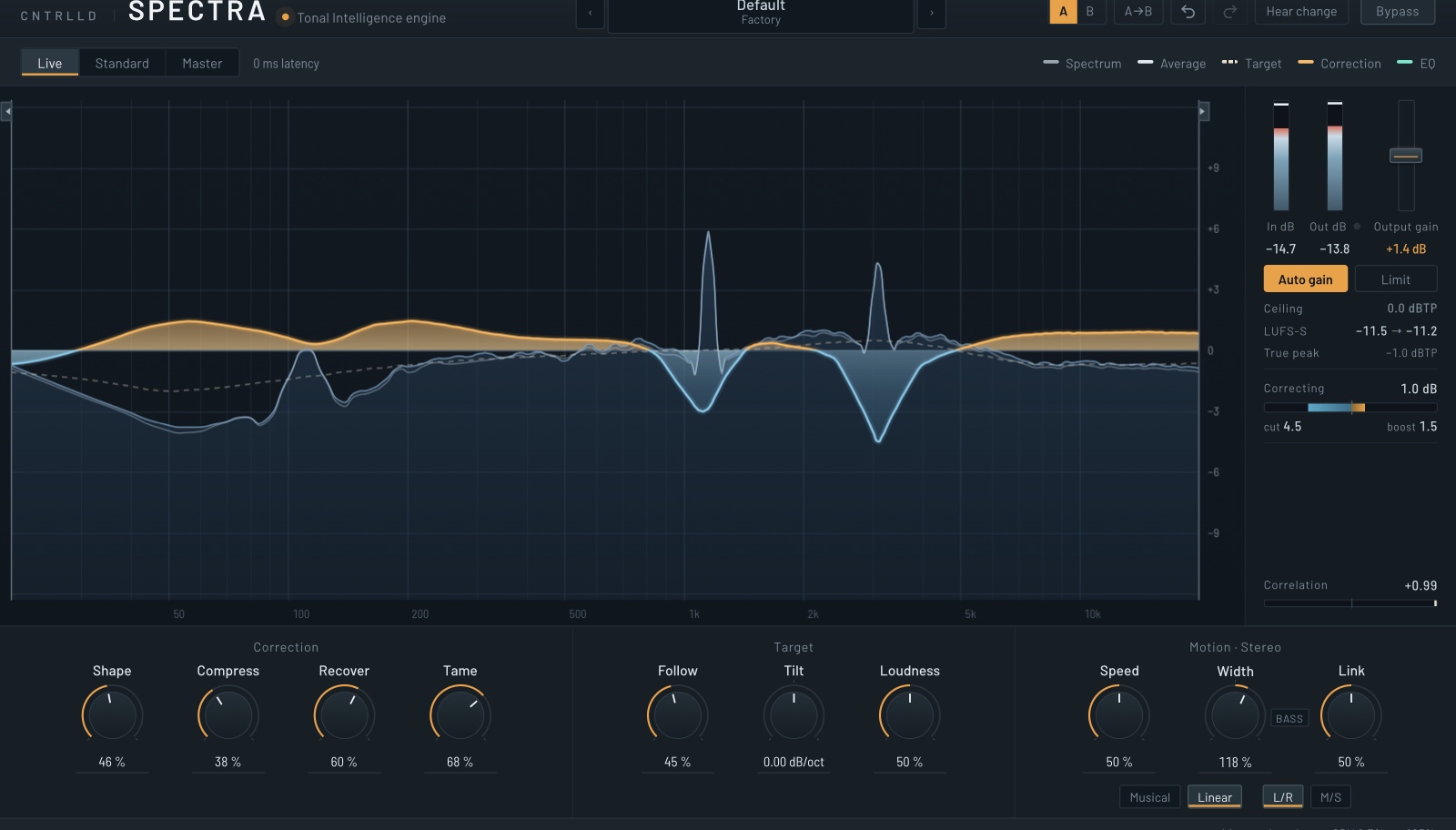
The analyser draws the correction as it is actually realised: amber where SPECTRA boosts, steel blue where it cuts. Rest on a knob and a short card explains it.
Specs
Details can still change before release.
| Formats | VST3 and AUWindows (VST3) is on the way |
|---|---|
| macOS | macOS 11 or later, Apple SiliconIntel support is planned for release |
| Sample rates | 44.1 to 192 kHz |
| Latency | Live 0 ms · Standard 4 ms · Master 100 ms+1.35 ms with the limiter on. Reported to the host. |
| Channels | Mono and stereoIn stereo, as L/R or M/S. On a mono track Width, Link and M/S simply have nothing to work on. |
| Tested hosts | Reaper and Logic ProValidated with pluginval at its strictest level and with Apple’s auval on every build. |
| CPU | About 7 % of one core at 48 kHzMeasured on an M2 Pro with everything turned up; 96 kHz roughly doubles it. |
| Licence | A signed licence with your name on itWorks on up to three of your own computers. No activation server, no iLok, no dongle. |
| Trial | 30 days, nothing held back |
SPECTRA is macOS only today — VST3 and AU, Apple Silicon. The Windows version (VST3) is being built. Leave your address and we'll write to you the day it's out.
One e-mail, about the Windows release. Nothing else, and you can stop it with one click. We ask you to confirm by e-mail first.
Try or buy
Download the full version and use it on your own material for 30 days. Buy it when you are convinced: the trial and the paid plug-in are the same download, and your licence simply switches the clock off.
SPECTRA is in beta while version 1 is being finished, and it is on sale at the introductory price for that reason. Buy today and you get the build that is out now plus every update up to and including the release — there is nothing more to pay at version 1.
€149 — introductory price while SPECTRA is being finished. It goes to €149 when version 1 lands. Incl. VAT.
Beta — current build …, release included
Thank you — your licence is on its way by e-mail, and it is always waiting in your account. Taking you to the download…
Prices include VAT where applicable. Refund policy
Questions
Partly. It measures the spectrum continuously and applies a correction that changes over time, towards a target. The EQ nodes you draw don’t filter the output directly; they change that target. So it’s closer to an automatic engineer with a brief than to a static EQ.
Live for recording and anything monitored in real time, Standard for mixing, Master for mastering when you want no phase shift at all. They steer towards the same curve, so you can set up in Live and switch to Master for the bounce.
Yes. The output is identical at every buffer size, so an offline render at a different block size gives the same result as what you heard.
Every variant can run the whole engine on mid and side separately. The side’s correction fades out when the side is nearly empty, so it won’t boost noise.
The friendly kind. Your licence is a short piece of text with your name and e-mail in it, signed by us. SPECTRA checks it on your own machine: no activation server to call, no iLok, no dongle, and the same licence works on up to three computers you use yourself.
Try the 30-day trial first — that is exactly what it is for. If you bought SPECTRA and it will not run properly on your machine, write to us within 14 days; we will try to fix it, and refund you if we cannot. See the refund policy.
Yes: the full plug-in for 30 days, with nothing held back — no noise bursts, no disabled controls. After that it stops passing audio until you activate it.